
Doctor of Philosophy in Management
The ultimate distinction for visionary leaders and accomplished professionals who demand more than conventional success. Designed for those who aspire to redefine strategy, innovation, and leadership at the highest level, this prestigious doctoral program fuses academic rigor with real-world relevance.

What is a PhD?
A PhD (Doctor of Philosophy) is the highest academic degree awarded in a field of study. It represents advanced mastery of theory, research, and critical thinking, achieved through independent scholarly inquiry rather than classroom instruction alone.
Unlike taught degrees, a PhD is fundamentally research-driven. Candidates are expected to investigate a focused topic in depth, develop original ideas, and produce a substantial dissertation that demonstrates intellectual rigor, analytical capability, and contribution to knowledge or practice within their discipline.
A PhD is not about memorizing content or passing routine exams. It is about learning how to think at the highest level, questioning assumptions, synthesizing complex information, and defending ideas with evidence and logic.
Traditionally, individuals pursue a PhD to:
- Advance academic or research expertise
- Develop high-level analytical and strategic thinking
- Establish authority in a specialized field
- Engage in deep intellectual and professional development
At its core, a PhD signifies intellectual independence. It marks the transition from being a consumer of knowledge to a creator of it.

Who is this for?
The Doctor of Philosophy (PhD) in Management is intended for experienced professionals and independent scholars who seek advanced academic engagement through structured research and critical inquiry.
This program is suitable for:
- Senior executives and organizational leaders seeking to deepen strategic and managerial understanding
- Entrepreneurs and founders aiming to formalize professional insight through doctoral-level research
- Management consultants and advisors who wish to strengthen analytical and theoretical expertise
- Experienced professionals pursuing advanced intellectual or scholarly development
- Independent researchers and lifelong learners capable of sustained, self-directed study
This program may not be suitable for:
- Individuals requiring a government-recognized or state-accredited doctoral qualification
- Candidates seeking a taught, classroom-based doctoral structure
- Applicants whose primary objective is professional licensure or regulatory recognition
This program is designed for candidates who value academic rigor, intellectual independence, and research-driven learning, and who understand the nature and purpose of a private, non-state-accredited doctoral award.
Online PhD
An Online PhD is a doctoral program delivered through digital and remote study formats, allowing candidates to pursue advanced research without the need for on-campus attendance.
Unlike traditional campus-based doctorates, an online PhD emphasizes independent study, structured supervision, and research flexibility, making it suitable for experienced professionals who must balance academic work with professional responsibilities.
Key characteristics of an online PhD include:
- Remote access to academic materials and supervision
- Flexible research schedules aligned with professional commitments
- Emphasis on original research and dissertation development
- Limited or no classroom-based instruction
An online PhD maintains the core expectations of doctoral-level study—critical analysis, methodological rigor, and scholarly contribution—while offering a mode of delivery that accommodates global and working candidates.
Online doctoral programs are best suited for individuals who are self-disciplined, academically prepared, and capable of managing long-term independent research.
Course Content
Module 1: Advanced Business Research Methods
| Topic | Description |
|---|---|
| Module 1.1. Philosophical foundations of research (positivism vs. interpretivism) | Examines epistemological and ontological perspectives. |
| Module 1.2 Quantitative Research Methodologies and Statistical Analysis | Develops skills in quantitative research design, data analysis, and statistical techniques. |
| Module 1.3 Qualitative Research Methodologies and Case Study Approaches | Explores qualitative methods, including interviews, observations, and case studies. |
| Module 1.4 Mixed-Method Research Techniques in Business | Introduces integrated research designs that combine quantitative and qualitative methods. |
| Module 1.5 Writing Research Proposals and Designing Empirical Studies | Focuses on structuring research proposals and formulating research questions. |
| Assessment | Exam |
Module 2: Strategic Management Process
| Topic | Description |
|---|---|
| Module 2.1 Theories of Strategic Management and Business Policy | Review classical and contemporary strategic management theories. |
| Module 2.2 Competitive Dynamics and Sustainable Advantage | Analyze industry competition, strategic positioning, and mechanisms |
| Module 2.3 Resource-Based View (RBV) and Dynamic Capabilities | Examines internal resources, capabilities, and organizational adaptability |
| Module 2.4 Corporate Governance and Ethical Decision-Making | Explores governance structures, ethical frameworks. |
| Module 2.5 Global Strategy and International Business | Evaluates strategic approaches to international expansion. |
| Assessment | Exam |
Module 3: Organizational Behavior and Leadership Theory
| Topic | Description |
|---|---|
| Module 3.1 Psychological and Sociological Perspectives on Organizations | Analyzes individual and group behavior in organizations. |
| Module 3.2 Leadership Styles, Transformational Leadership, and Servant Leadership | Examines major leadership theories and their impact. |
| Module 3.3 Motivation Theories and Employee Engagement Strategies | Explores motivational models and engagement practices. |
| Module 3.4 Change Management and Organizational Development | Studies frameworks and tools for managing organizational change. |
| Module 3.5 Cross-Cultural Leadership and Global Management Practices | Analyzes leadership challenges and practices |
| Assessment | Exam |
Module 4: Financial Management and Corporate Decision-Making
| Topic | Description |
|---|---|
| Module 4.1 Advanced Financial Theories and Corporate Finance Strategies | Explores financial theories and strategic approaches to corporate financing and investment decisions. |
| Module 4.2 Risk Management, Capital Structure, and Financial Modeling | Examines financial risk assessment, capital structure decisions, and modeling techniques |
| Module 4.3 Behavioral Finance and Decision-Making Biases | Analyzes psychological factors and cognitive biases influencing financial decision-making. |
| Module 4.4 Mergers, Acquisitions, and Corporate Restructuring | Studies strategic, financial, and organizational aspects of mergers, acquisitions, etc. |
| Module 4.5 Ethical Considerations in Financial Management | Examines ethical standards and governance issues affecting financial management practices. |
| Assessment | Exam |
Module 5: Marketing Theory and Consumer Behavior
| Topic | Description |
|---|---|
| Module 5.1 Foundations of Marketing Theory and Strategy | Introduces core marketing concepts and strategic frameworks for value creation and market positioning. |
| Module 5.2 Consumer Behavior Psychology and Decision-Making Models | Examines psychological and behavioral factors influencing consumer decision-making processes. |
| Module 5.3 Digital Marketing Trends and Artificial Intelligence in Marketing | Explores emerging digital marketing practices, including data-driven and AI-enabled marketing strategies. |
| Module 5.4 Global Marketing Strategies and Brand Management | Analyzes brand development and marketing strategy across international and multicultural markets. |
| Module 5.5 Ethical Considerations in Marketing Research | Examines ethical standards, data integrity, and responsible conduct in marketing research activities. |
| Assessment | Exam |
Module 6: Innovation and Entrepreneurship
| Topic | Description |
|---|---|
| Module 6.1 Theories of Innovation and Business Model Evolution | Examines innovation frameworks and the evolution of business models in dynamic markets. |
| Module 6.2 Entrepreneurial Finance and Venture Capital Strategies | Analyzes funding mechanisms, valuation approaches, and financial strategies for entrepreneurial ventures. |
| Module 6.3 Technology-Driven Business Transformation | Explores how digital technologies drive organizational change and competitive differentiation. |
| Module 6.4 Social Entrepreneurship and Impact-Driven Business Models | Examines entrepreneurial approaches that integrate social impact with economic sustainability. |
| Module 6.5 Scaling Start-ups and Corporate Entrepreneurship | Studies growth strategies, organizational scaling, and entrepreneurial activity within established firms. |
| Assessment | Exam |
Module 7: Operations and Supply Chain Management
| Topic | Description |
|---|---|
| Module 7.1 Advanced Supply Chain Management and Logistics Optimization | Analyzes supply chain design, logistics coordination, and performance optimization strategies. |
| Module 7.2 Lean Management and Six Sigma Methodologies | Examines process improvement techniques aimed at efficiency, quality, and waste reduction. |
| Module 7.3 Sustainable Operations and Circular Economy Practices | Explores sustainability-driven operational strategies and circular economy principles. |
| Module 7.4 Digital Transformation in Supply Chain Management | Analyzes the role of digital technologies in enhancing supply chain visibility and integration. |
| Module 7.5 Risk Mitigation and Crisis Management in Global Supply Chains | Examines risk identification, resilience planning, and crisis response in global supply networks. |
| Assessment | Exam |
Module 8: Global Business and Emerging Markets
| Topic | Description |
|---|---|
| Module 8.1 Macroeconomic Trends and Business Implications | Analyzes global macroeconomic trends and their strategic implications for organizations. |
| Module 8.2 International Trade Policies and Economic Agreements | Examines trade frameworks, agreements, and policy environments affecting international business. |
| Module 8.3 Market Entry Strategies in Emerging Economies | Explores strategic approaches to entering and operating in emerging market contexts. |
| Module 8.4 Multinational Corporations and Foreign Direct Investment (FDI) | Analyzes multinational strategies, investment decisions, and cross-border operational models. |
| Module 8.5 Geopolitical Risks and Global Business Resilience | Examines geopolitical dynamics and strategies for building organizational resilience. |
| Assessment | Exam |
Module 9: Business Ethics, Corporate Governance, and Sustainability
| Topic | Description |
|---|---|
| Module 9.1 Corporate Social Responsibility (CSR) and Sustainability Strategies | Examines CSR frameworks and sustainability initiatives within organizational strategy. |
| Module 9.2 Ethical Leadership and Decision-Making Frameworks | Analyzes ethical leadership models and structured approaches to ethical decision-making. |
| Module 9.3 Stakeholder Theory and Business Accountability | Explores stakeholder relationships and mechanisms for corporate accountability. |
| Module 9.4 ESG (Environmental, Social, Governance) Considerations in Business | Examines environmental, social, and governance factors. |
| Module 9.5 The Role of Businesses in Social Impact and Economic Development | Analyzes how organizations contribute to social outcomes and economic development initiatives. |
| Assessment | Exam |
Module 10: Digital Transformation and Business Analytics
| Topic | Description |
|---|---|
| Module 10.1 The Role of Artificial Intelligence and Big Data in Business Strategy | Explores the strategic use of AI and big data in organizational decision-making. |
| Module 10.2 Cybersecurity, Data Privacy, and Ethical Concerns in Digital Business | Examines cybersecurity risks, data protection, and ethical challenges in digital environments. |
| Module 10.3 Business Intelligence and Predictive Analytics | Analyzes data-driven tools and predictive models supporting strategic decisions. |
| Module 10.4 The Impact of Automation on Business Operations | Examines how automation reshapes operational processes and workforce structures. |
| Module 10.5 Digital Ecosystems and Platform-Based Business Models | Explores platform strategies and ecosystem-based approaches to value creation. |
| Assessment | Exam |
Module 11: Advanced Economic and Policy Analysis
| Topic | Description |
|---|---|
| Module 11.1 Microeconomic and Macroeconomic Theories in Business | Applies economic theory to strategic and operational business decision-making. |
| Module 11.2 Policy Analysis and Its Impact on Corporate Strategies | Examines how public policy and regulation influence corporate strategy and performance. |
| Module 11.3 Government-Business Relationships and Regulatory Environments | Analyzes regulatory systems and interactions between governments and organizations. |
| Module 11.4 Economic Forecasting and Decision-Making | Explores forecasting methods and their role in strategic planning. |
| Module 11.5 Emerging Trends in Global Financial Markets | Analyzes structural changes and emerging dynamics in global financial markets. |
| Assessment | Exam |
Module 12: Dissertation and Research Development
| Topic | Description |
|---|---|
| Dissertation and Research Development | Explore the principles and techniques of writing doctoral research, including structure, methodology, and presentation. |
Career Options After Graduation
PhD graduates possess advanced business knowledge and leadership skills, making them well-suited for a variety of leadership roles. Here are four leadership roles that PhD graduates can pursue:
Management Consultant
Role: Provides strategic advice to improve business performance and solve complex problems.
Average Salary: $90,000 – $150,000 per year
Investment Banker
Role: Assists with raising capital, advises on mergers and acquisitions, and handles financial restructuring.
Average Salary: $100,000 – $200,000 per year (plus potential bonuses)ort description.
Corporate Finance Manager
Role: Manages financial activities, including budgeting, forecasting, and financial analysis.
Average Salary: $85,000 – $130,000 per year
Marketing Manager
Role: Develops and implements marketing strategies to promote products or services and drive growth.
Average Salary: $80,000 – $120,000 per year
Operations Manager
Role: Oversees production and delivery, focusing on improving efficiency and effectiveness.
Average Salary: $75,000 – $115,000 per year
Others
An MBA is a versatile degree that opens doors to various other roles across different industries, including entrepreneurship, human resources, supply chain management, and more.
Degree Certificates
Upon successfully completing the Doctor of Philosophy in Management (PhD) program, graduates receive a PhD degree certificate, along with an official transcripts of records.
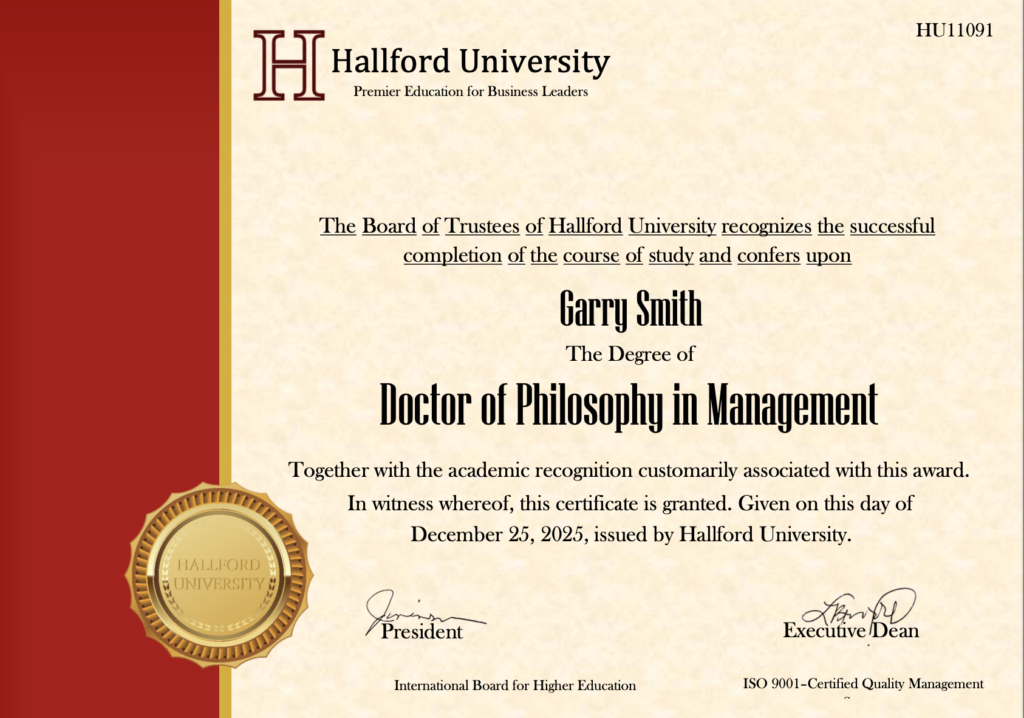
PhD Certificate
This prestigious certificate represents the highest academic achievement in business administration. Graduates are entitled to use the honorific title “Dr.” before their name, reflecting their advanced scholarly accomplishments and research expertise.
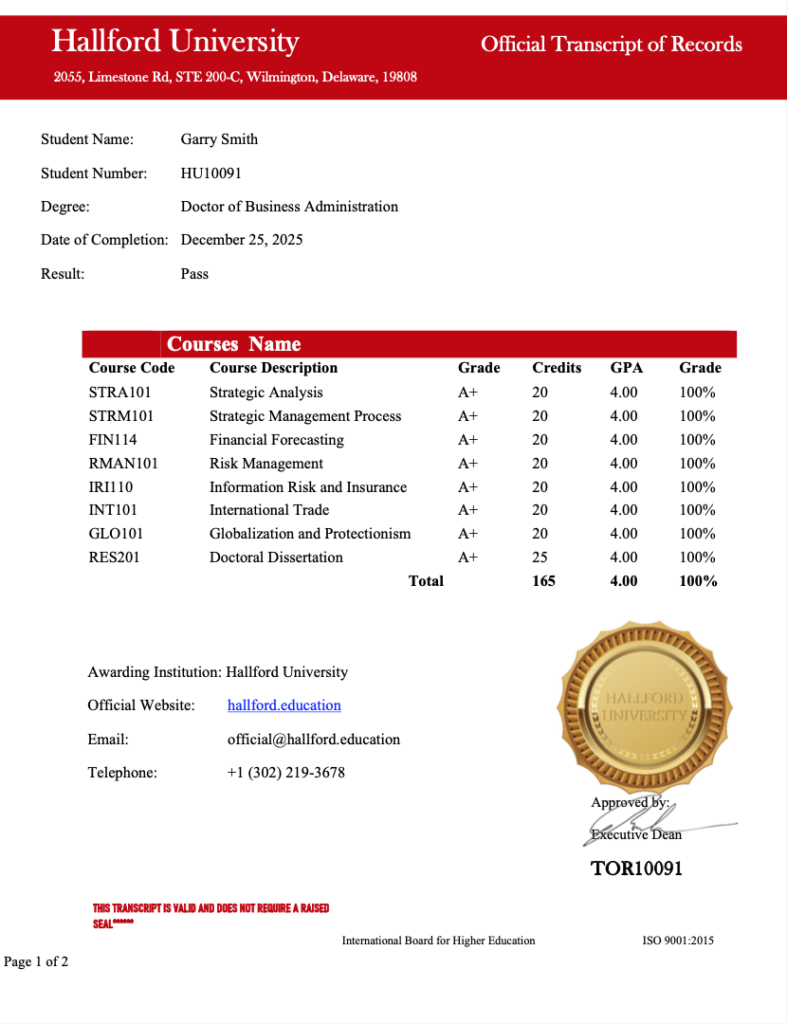
Official Transcript of Records
Graduates of the PhD program are awarded an official transcript of records, issued by the institution as formal recognition of their academic performance and program completion.
Students who successfully complete their program will be conferred an official certificate with a unique serial number and signature of the university president and executive dean. To verify your certificate, submit it to official@hallford.education.
Enrollment Form
Hear From Our Students
u0022Enrolling in the Dual MBA and DBA Program opened my perspective on the interconnected world of international business, global policy, and economics. The program provided a deep and structured understanding of how global markets operate, how companies collaborate across borders, and how cultural and economic diversity drive growth.u0022

“My experience at Hallford University has been truly transformative. The program’s professional and well-structured content was both practical and deeply relevant to my field. I appreciated how each module connected theory with real-world business applications, allowing me to immediately apply what I learned in my professional environment.u0022

“It has been a very interesting and refreshing experience, both professionally and academically. The DBA program continuously challenged me to combine my background in Economics and Finance with a wider perspective into Business and Marketing.”

“My experience at Hallford University was both exciting and intellectually rewarding. The program was professionally structured and excellently packaged, making each lesson practical and relevant to real business challenges.u0022u003cbru003e

“My experience at Hallford University has been truly rewarding and empowering. The MBA and DBA programs provided the flexibility, affordability, and academic depth I needed to advance both my professional and personal development.u0022

“My experience at Hallford University was both enriching and transformative. The program strengthened my understanding of business strategy and international trade, equipping me with practical skills that I now apply directly in my leadership roles.u0022

u0022The MBA/DBA Dual Degree program challenged me to think beyond traditional finance — to integrate strategic leadership, innovation, and data-driven decision-making. These are skills that define the next generation of global business leaders.u0022

“Hallford provided me with an excellent, economical, efficient way to obtain a worthwhile DBA while working full time. Without their well-thought-out course and dissertation formats, I wouldn’t have been able to pursue a doctorate without temporarily leaving my role in the defense industry. I highly recommend Hallford University for those who want to elevate their business education without sacrificing professional experience.”

“My experience at Hallford University has been both intellectually enriching and professionally transformative. The MBA program provided a powerful foundation in strategic management, leadership, finance, and organizational behavior, equipping me to make data-driven decisions and manage complex business challenges with confidence.

“My academic journey at Hallford University has been both transformative and deeply fulfilling. Completing my Master of Business Administration and later my Doctor of Business Administration equipped me with advanced analytical, managerial, and research skills that have profoundly shaped my professional and academic career.u0022

“My overall experience at Hallford University was very positive. The courses were well-organized, engaging, and supported by knowledgeable instructors. The online format allowed me to balance my responsibilities while developing strong academic and professional skills. It was a rewarding journey that helped me grow as a leader, researcher, and strategic thinker.”

ACCREDITATIONS
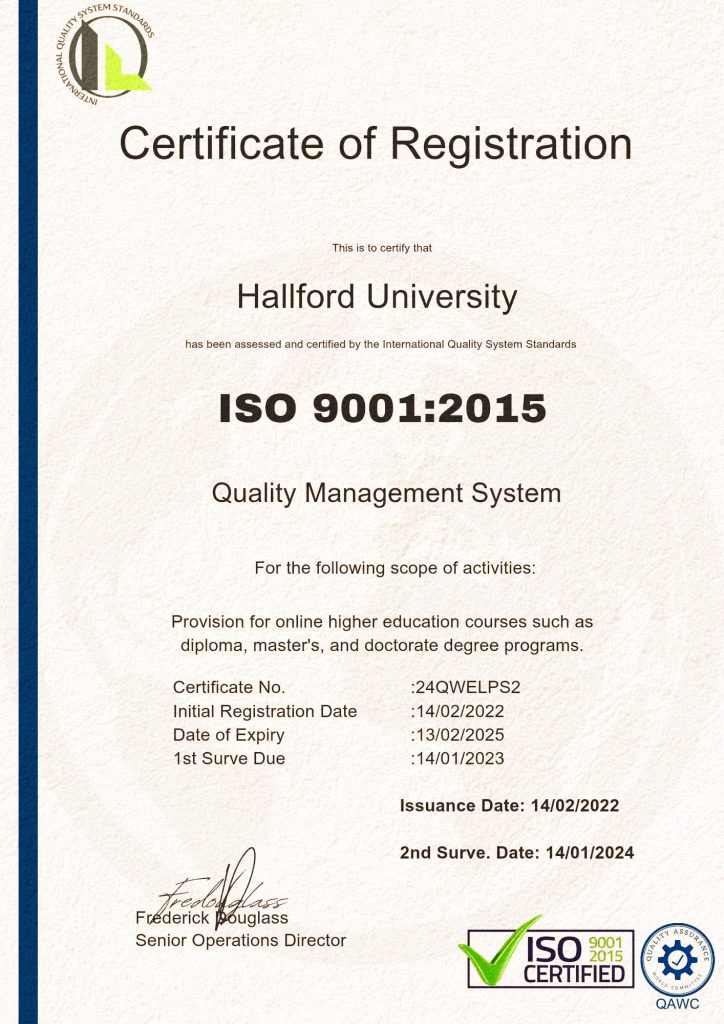
At Hallford University, we’re thrilled to share that we are an ISO 9001: 2015 certified organization and accredited by the International Board for Higher Education. These recognitions is like a badge of honor for us, and it signifies our deep commitment to providing top-notch education.
You might be wondering, what does accreditation really mean? Well, it’s like a seal of approval from experts in the field of education. They’ve taken a close look at our programs, our faculty, and our overall operations, and they’ve given us a big thumbs-up. It’s a way of saying that we’re doing things the right way and maintaining high standards.
This accreditation isn’t just a piece of paper; it’s a reflection of the hard work and dedication of our entire team, from our educators to our support staff. We’re all in this together, with one goal in mind: to provide you, our students, with an outstanding education.

IBHE Certificate of Accredition
What it means for you is that when you choose Hallford University, you’re choosing an institution that’s been recognized for its commitment to quality. You can trust that the education you receive here meets or even exceeds the standards set by experts in the field.
So, when you embark on your educational journey with us, know that you’re not just enrolling in a university; you’re joining a community of learners dedicated to helping you achieve your academic and professional goals. We’re here to support you every step of the way, and our accreditation is a testament to our promise of delivering a world-class education to learners from all walks of life.
Academic Status and Accreditation
Hallford University is a private, independently governed institution offering academically rigorous programs designed for advanced study and professional development. The University upholds its academic standards through independent accreditation and external quality-assurance frameworks, including accreditation by the International Board of Higher Education (IBHE), an independent, non-government accrediting institution.
Operating under a private governance model, Hallford University functions outside government or state-administered accreditation systems. Its academic programs and awards therefore represent distinct qualifications, separate from those issued under government-recognized or state-authorized frameworks.
Hallford University programs are designed for executive education, professional advancement, independent academic inquiry, and personal scholarly development. Recognition or acceptance of qualifications may vary by employer, institution, or jurisdiction.
learn more
-
Why 1 Year MBA Programs Online Are the Smartest Career Move This Year
January has a way of stirring reflection. The holidays fade, the coffee tastes a little stronger, and suddenly that job you were perfectly content with in November feels… constraining. You scroll LinkedIn, see former classmates posting about promotions, and wonder: Did I stall? If that sounds familiar, you’re not failing. You’re just paying attention. Increasingly,…
-
Closing the Year: Advancing Online Business Education for Professionals
Online MBA and DBA programs continue to reshape how professionals pursue advanced business education. As the year draws to a close, Hallford University reflects on a period of focused institutional development and steady progress in delivering online business programs for professionals who want credible qualifications without pausing their careers. The past year was not about…
-
Best 1 Year MBA Programs Online for Working Professionals (2025 Guide)
For experienced professionals who want to advance their careers without stepping away from For experienced professionals who want to advance their careers without stepping away from full-time work, 1 year MBA programs online—often referred to as a fast track online MBA programs—have become a popular option in 2025. As employers place greater emphasis on demonstrated…
-
Is an Online MBA Worth It in 2025? Real ROI, Salary & Career Data
Introduction: The MBA Dilemma in 2025 Let’s cut to the chase.In 2025, business professionals are standing at a crossroads.On one side: inflation, AI-driven job shifts, and a competitive global market.On the other: the promise of an Online MBA , flexible, remote, and career-boosting… supposedly. But is it actually worth it?Or just another expensive piece of…
-
Is an Online DBA Worth It? Here’s What You Need to Know
If you’re a business professional looking to advance your career, specialize in executive leadership, or transition into consulting or academia, pursuing an online Doctor of Business Administration (DBA) could be a game-changing move. But with so many options and opinions out there, one big question remains: Is an online DBA degree really worth it? Let’s…
-
The Importance of Lifelong Learning: Continuing Education at Hallford University
In today’s fast-paced, ever-changing world, one thing is clear: learning never stops. No matter your career stage or field of expertise, staying current with new skills, trends, and technologies is crucial to both personal and professional growth. At Hallford University, we believe in the power of lifelong learning, which is why we offer a wide range of continuing…