
Master of Business Administration
An Executive MBA for those who’ve achieved success, and are hungry for more. Elevate your strategic vision, expand your global influence, and shape the future of business.

Transform How You Think, Lead, and Win.
You don’t have time for outdated theory or rigid schedules, and you shouldn’t have to.
The Online MBA gives you the flexibility to study around your life while gaining the strategic insight, business acumen, and leadership mindset demanded by today’s global economy.
It’s built for professionals who want to move beyond managing tasks to leading transformation, for those ready to make sharper decisions, influence outcomes, and drive growth across industries.
Who is this for?
This MBA is built for professionals who want more: more influence, more clarity, more growth. It’s designed for ambitious achievers who have proven themselves in their field and are ready to lead at a higher level.
Whether you are a manager stepping into executive leadership, an entrepreneur scaling your vision, or a specialist ready to expand your impact, this program gives you the strategic mindset and real-world edge to make it happen.
You will learn to think like a leader, make confident decisions, and drive results that move organizations forward. Flexible, rigorous, and focused on real outcomes, the MBA empowers you to accelerate your career without putting your life on hold.
This is not just a degree. It is your next competitive advantage.
MBA Curriculum Overview
Master the Core of Modern Business
Module 1: International Management
| Topic | Description |
|---|---|
| 1.1 The Importance of International Management | Learn why effective international management is key to thriving in a global economy. |
| 1.2 Hofstede’s Cultural Framework | Explore how Hofstede’s model helps decode cultural values that shape workplace dynamics. |
| 1.3 The GLOBE Framework | Understand global leadership trends and how culture influences management styles. |
| 1.4 Cultural Stereotyping and Social Institutions | Examine how cultural assumptions and social norms impact global business interactions. |
| 1.5 Cross-Cultural Assignments | Gain insights into adapting and succeeding in international work environments. |
| 1.6 Strategies for Expanding Globally | Study the main strategies organizations use to enter and grow in foreign markets. |
| 1.7 The Necessity of Global Markets | Discover why expanding into global markets is essential for long-term growth and competitiveness. |
| Assessment | Demonstrate your understanding of international management through applied evaluation. |
Module 2: Marketing Management
| Topic | Description |
|---|---|
| 2.1 The Marketing Concept | Understand how the marketing concept focuses on creating value by meeting customer needs. |
| 2.2 Marketing Strategy | Learn how organizations design and implement strategies to achieve marketing goals. |
| 2.3 Developing a Marketing Mix | Explore how product, price, place, and promotion work together to drive success. |
| 2.4 Buyer Behavior | Examine what motivates consumers and how they make purchasing decisions. |
| 2.5 Market Segmentation | Discover how dividing markets into segments helps businesses target customers effectively. |
| 2.6 What is a Product? | Understand what defines a product and how it fits within the marketing mix. |
| 2.7 Creating Products That Deliver Value | Learn how to design and position products that meet customer expectations and build loyalty. |
| 2.8 The Product Life Cycle | Study the stages of a product’s journey and how strategies evolve from launch to decline. |
| 2.9 Pricing Strategies | Explore how pricing decisions influence perception, demand, and profitability. |
| 2.10 Trends in Developing Products and Pricing | Stay updated on emerging trends that reshape product development and pricing models. |
| Assessment | Apply your knowledge to analyze and create effective marketing solutions. |
Module 3: Accounting
| Topic | Description |
|---|---|
| 3.1 Introduction | Gain an overview of accounting’s role in business and why financial literacy is essential for effective decision-making. |
| 3.2 The Accounting Profession | Explore the functions, responsibilities, and ethics that define the modern accounting profession. |
| 3.3 Basic Accounting Procedures | Learn the foundational processes for recording, classifying, and summarizing financial transactions. |
| 3.4 The Balance Sheet | Understand how assets, liabilities, and equity reveal a company’s financial position. |
| 3.5 The Income Statement | Examine how revenues and expenses determine profitability and performance. |
| 3.6 Cash Flow Statement | Discover how cash inflows and outflows reflect a business’s liquidity and financial health. |
| 3.7 Analyzing Financial Statements | Develop the skills to interpret and evaluate financial data for strategic insight. |
| 3.8 Trends in Accounting | Stay informed on emerging technologies, standards, and global shifts shaping the future of accounting. |
| Assessment | Apply key accounting principles to analyze real-world financial situations. |
Module 4: Financial Management
| Topic | Description |
|---|---|
| 4.1 Introduction | Understand the fundamentals of financial management and its importance in organizational success. |
| 4.2 How Organizations Use Funds | Learn how businesses allocate and manage funds to support operations and growth. |
| 4.3 Obtaining Short-Term Financing | Explore methods companies use to secure short-term funding for immediate financial needs. |
| 4.4 Raising Long-Term Financing | Discover how organizations acquire long-term capital to finance major investments and expansion. |
| 4.5 Equity Financing | Understand how businesses raise funds by offering ownership shares to investors. |
| 4.6 Securities Markets | Examine how financial markets facilitate the trading of stocks, bonds, and other securities. |
| 4.7 Buying and Selling at Securities Exchanges | Learn how securities are traded and what drives market activity and investment decisions. |
| 4.8 Trends in Financial Management and Securities Markets | Stay updated on emerging trends and technologies transforming finance and investment. |
| Assessment | Demonstrate your understanding of financial management through applied analysis and evaluation. |
Module 5: Human Resource Management
| Topic | Description |
|---|---|
| 5.1 Achieving High Performance | Learn how effective human resource practices drive productivity, engagement, and organizational success. |
| 5.2 Employee Recruitment | Understand how to attract and identify the right talent for business growth. |
| 5.3 Employee Selection | Explore methods for evaluating candidates and making strategic hiring decisions. |
| 5.4 Employee Training and Development | Discover how continuous learning enhances employee skills and long-term performance. |
| 5.5 Performance Planning and Evaluation | Learn how to set clear goals, assess results, and support employee improvement. |
| 5.6 Employee Compensation and Benefits | Examine how fair pay and benefits systems motivate, retain, and reward employees. |
| 5.7 The Labor Relations Process | Understand how employers and unions collaborate to maintain effective workplace relations. |
| 5.8 Managing Grievances and Conflicts | Develop strategies for resolving workplace issues and maintaining a positive environment. |
| 5.9 Legal Environment of Human Resources and Labor Relations | Learn about the key laws and regulations that shape HR policies and protect employee rights. |
| 5.10 Trends in Human Resources | Stay informed on evolving practices and technologies transforming the HR landscape. |
| Assessment | Apply HR principles to real-world scenarios that test your ability to manage people effectively. |
Module 6: Supply Chain and Distribution
| Topic | Description |
|---|---|
| 6.1 The Nature of Distribution | Understand how distribution connects producers to consumers and drives business success. |
| 6.2 Wholesaling | Learn how wholesalers bridge the gap between manufacturers and retailers to streamline supply. |
| 6.3 Retailing | Explore how retailers create value by delivering products and experiences directly to customers. |
| 6.4 Using Supply Chain to Increase Efficiency | Discover how effective supply chain management reduces costs and improves delivery performance. |
| Assessment | Demonstrate your understanding of distribution and supply chain strategies through applied analysis. |
Career Options After Graduation
MBA graduates possess advanced business knowledge and leadership skills, making them well-suited for a variety of leadership roles. Here are five leadership roles that MBA graduates can pursue:
Management Consultant
Role: Provides strategic advice to improve business performance and solve complex problems.
Average Salary: $90,000 – $150,000 per year
Investment Banker
Role: Assists with raising capital, advises on mergers and acquisitions, and handles financial restructuring.
Average Salary: $100,000 – $200,000 per year (plus potential bonuses)ort description.
Corporate Finance Manager
Role: Manages financial activities, including budgeting, forecasting, and financial analysis.
Average Salary: $85,000 – $130,000 per year
Marketing Manager
Role: Develops and implements marketing strategies to promote products or services and drive growth.
Average Salary: $80,000 – $120,000 per year
Operations Manager
Role: Oversees production and delivery, focusing on improving efficiency and effectiveness.
Average Salary: $75,000 – $115,000 per year
Others
An MBA is a versatile degree that opens doors to various other roles across different industries, including entrepreneurship, human resources, supply chain management, and more.
Degree Certificates
Upon successfully completing the Master of Business Administration (MBA) program, graduates receive an MBA degree certificate, along with an official transcript of records.
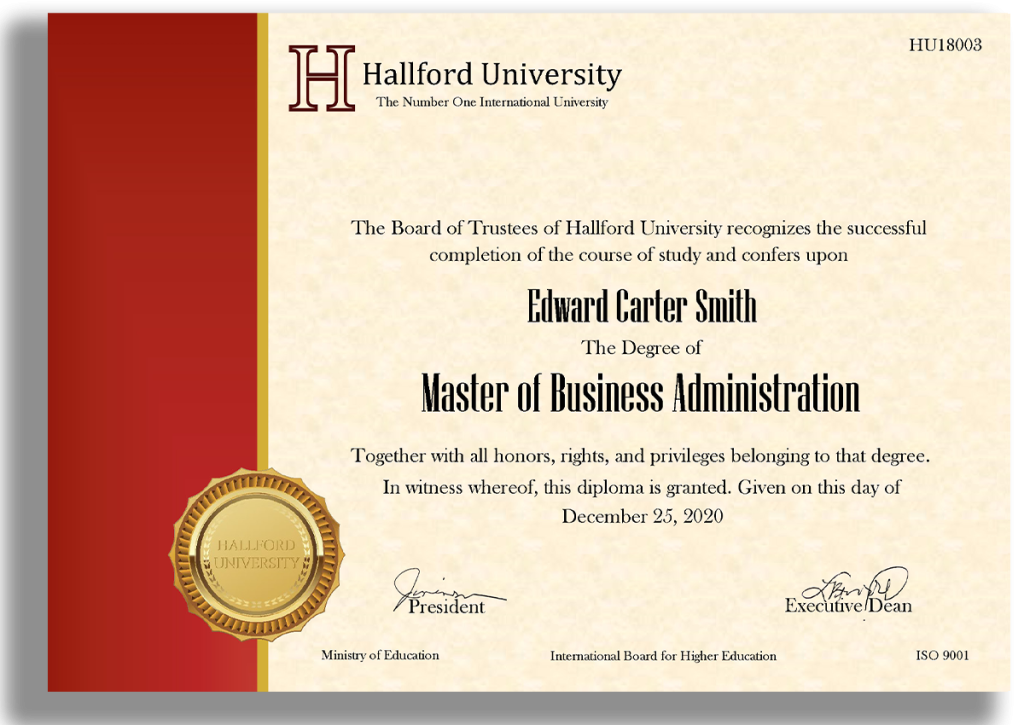
MBA Certificate
This certificate signifies a high level of expertise in business management and strategy, enhancing career prospects and opening doors to advanced professional opportunities.
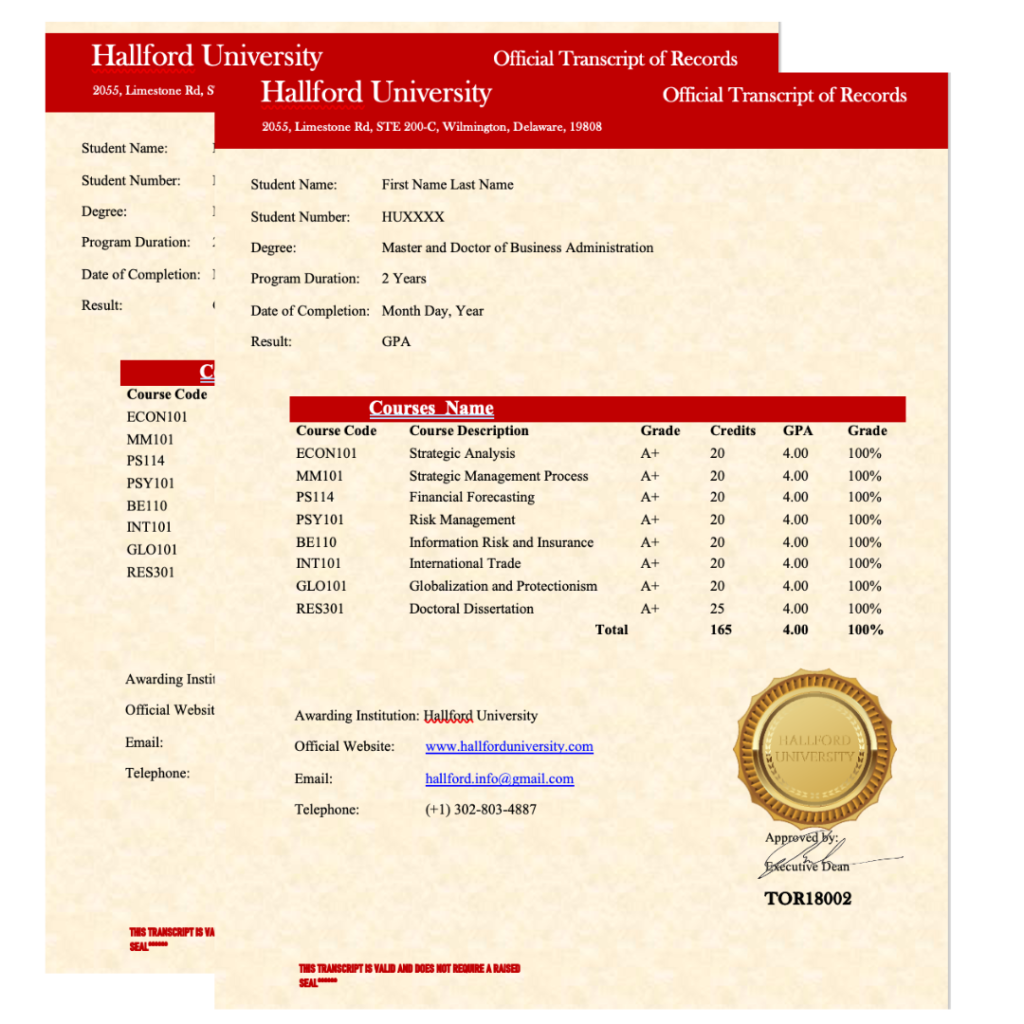
Official Transcript of Records
Graduates of the MBA program are awarded an official transcript of records, issued by the institution as formal recognition of their professional performance and program completion.
Students who successfully complete their program will be conferred an official certificate with a unique serial number and signature of the university president and executive dean. To verify your certificate, submit it to official@hallford.education.
Complete Your Enrollment at Hallford University
Join an international community of business leaders. Finalize your enrollment to begin your Hallford University experience. Secure your seat and receive your student access within 24 hours.
ACCREDITATIONS
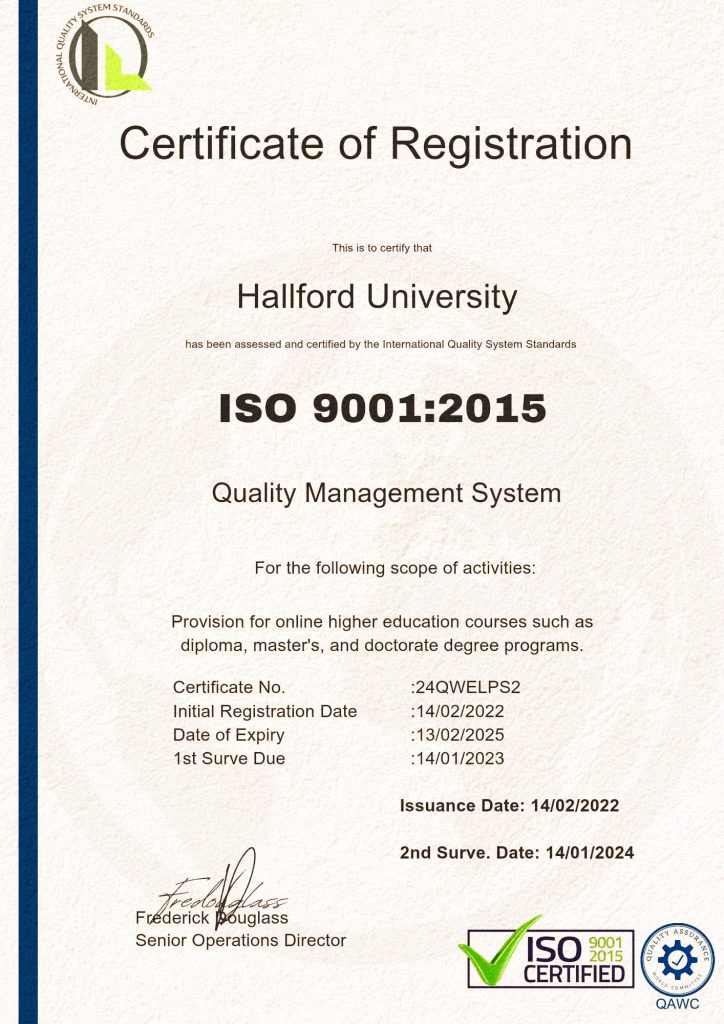
ISO 9001:2015 Certified
Hallford University earned the ISO 9001:2015 certification from the International Quality System Standards (IQSS) on February 14, 2022, recognizing its excellence in quality management and commitment to continuous improvement.
This globally respected certification affirms that Hallford University adheres to the rigorous ISO 9001 standards, ensuring its operations, academic programs, and services consistently meet international benchmarks for quality. It reflects the university’s dedication to meeting student, statutory, and regulatory requirements while maintaining a culture of accountability and excellence.
The ISO 9001:2015 certification reinforces Hallford University’s reputation as a trusted institution that delivers high-quality education and upholds world-class management practices.
IBHE Certificate of Accreditation
Hallford University earned accreditation from the International Board for Higher Education (IBHE) on April 2, 2022, following a comprehensive institutional review. This accreditation, valid through April 1, 2027, affirms the university’s excellence in academic quality and distance learning.
Recognized in over 40 countries, the IBHE is a globally respected accrediting body. Its endorsement confirms that Hallford University meets rigorous international standards and delivers top-tier, globally relevant education.
This accreditation strengthens the credibility of Hallford University’s programs and enhances the global value of its degrees, ensuring students and graduates are recognized and respected worldwide.

Hear From Our Students
“Enrolling in the Dual MBA and DBA Program opened my perspective on the interconnected world of international business, global policy, and economics. The program provided a deep and structured understanding of how global markets operate, how companies collaborate across borders, and how cultural and economic diversity drive growth.”

“My experience at Hallford University has been truly transformative. The program’s professional and well-structured content was both practical and deeply relevant to my field. I appreciated how each module connected theory with real-world business applications, allowing me to immediately apply what I learned in my professional environment.”

“It has been a very interesting and refreshing experience, both professionally and academically. The DBA program continuously challenged me to combine my background in Economics and Finance with a wider perspective into Business and Marketing.”

“My experience at Hallford University was both exciting and intellectually rewarding. The program was professionally structured and excellently packaged, making each lesson practical and relevant to real business challenges.”

“My experience at Hallford University has been truly rewarding and empowering. The MBA and DBA programs provided the flexibility, affordability, and academic depth I needed to advance both my professional and personal development.”

“My experience at Hallford University was both enriching and transformative. The program strengthened my understanding of business strategy and international trade, equipping me with practical skills that I now apply directly in my leadership roles.”

“The MBA/DBA Dual Degree program challenged me to think beyond traditional finance — to integrate strategic leadership, innovation, and data-driven decision-making. These are skills that define the next generation of global business leaders.”

“Hallford provided me with an excellent, economical, efficient way to obtain a worthwhile DBA while working full time. Without their well-thought-out course and dissertation formats, I wouldn’t have been able to pursue a doctorate without temporarily leaving my role in the defense industry. I highly recommend Hallford University for those who want to elevate their business education without sacrificing professional experience.”

“My experience at Hallford University has been both intellectually enriching and professionally transformative. The MBA program provided a powerful foundation in strategic management, leadership, finance, and organizational behavior, equipping me to make data-driven decisions and manage complex business challenges with confidence.

“My academic journey at Hallford University has been both transformative and deeply fulfilling. Completing my Master of Business Administration and later my Doctor of Business Administration equipped me with advanced analytical, managerial, and research skills that have profoundly shaped my professional and academic career.”

“My overall experience at Hallford University was very positive. The courses were well-organized, engaging, and supported by knowledgeable instructors. The online format allowed me to balance my responsibilities while developing strong academic and professional skills. It was a rewarding journey that helped me grow as a leader, researcher, and strategic thinker.”